From Coffee’s Origins to Hausbrandt: How Espresso Conquered Greece
Coffee has travelled a long way from wild shrubs in East Africa to your favourite Kolatsio Coffee & More in Thassos. Along the way, it created empires, inspired revolutions, and gave rise to brands like Hausbrandt that helped define Italian espresso culture – and, eventually, reshaped the Greek coffee market.
From Ethiopian Highlands to Ottoman Coffeehouses
Most historians agree that the coffee plant is native to Ethiopia, where beans were originally consumed for their stimulating effect, sometimes as a paste and sometimes as a drink. By the 14th–15th centuries, coffee cultivation had taken root in Yemen, where Sufi mystics used the beverage to stay awake during long nights of prayer and study.
From Yemen, coffee spread across the Islamic world – to Mecca, Cairo, Damascus and finally Istanbul, capital of the Ottoman Empire – becoming part of daily religious, commercial and social life. In Ottoman cities, coffeehouses quickly emerged as hubs of conversation, politics and commerce, a model that would later strongly influence Greek coffee culture under Ottoman rule.
Coffee Crosses into Europe
Coffee reached Europe in the 17th century, travelling on Mediterranean trade routes and entering through ports such as Venice and Malta. Venice saw some of the earliest European coffeehouses in the 1640s, serving an exotic and expensive drink that initially appealed to wealthy elites and curious intellectuals. Similar spaces soon appeared in Marseille, Paris, London and the major port cities of Central Europe, where coffeehouses became known as “penny universities” – places to debate philosophy, politics and science over a cup.
This early European coffee culture set the stage for later national traditions: Viennese cafés laden with pastries, Parisian literary haunts and, eventually, the modern Italian bar where a quick espresso at the counter became a daily ritual.
Trieste, a Port of Coffee – and the Birth of Hausbrandt
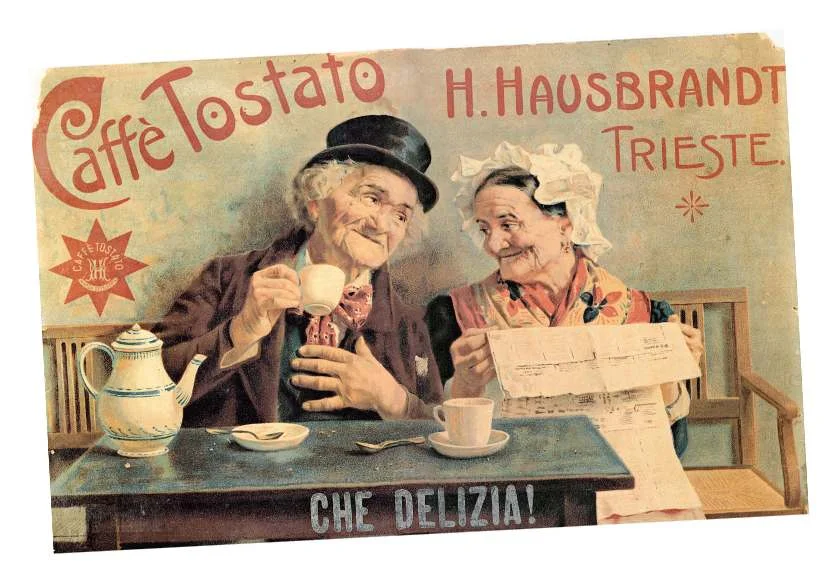
One of the key European gateways for coffee was Trieste, a major port city on the Adriatic that handled vast quantities of green coffee beans destined for Central Europe. It was here, in 1892, that Hermann Hausbrandt – an Austrian merchant‑marine captain – founded a roasting company that still bears his name: “Specialità Caffè Hausbrandt.”
Hausbrandt was a pioneer in treating coffee as a modern industrial product. The company was among the first to roast and blend coffee at scale, and crucially, to package its processed blends in sealed metal containers directly at the production plant, solving persistent problems of transport, freshness and aroma loss. In an era when many cafés still roasted on site with uneven results, this was a small revolution: consistent quality, stable blends and coffee that travelled well across borders.
Throughout the 20th century, Hausbrandt weathered wars and market shocks, growing into one of Italy’s leading roasting industries while keeping strong roots in Trieste and later expanding production to modern plants in northern Italy. From the late 1980s, under the entrepreneurial leadership of Martino Zanetti, the brand was repositioned towards premium, carefully researched blends and an international strategy that today sees Hausbrandt espresso served in more than 90 countries.
Italian Espresso Culture and Hausbrandt’s Style
Espresso, as we know it today, emerged from Italian engineering in the late 19th and early 20th centuries, when pressure‑based machines allowed baristi to pull a concentrated shot of coffee in seconds rather than minutes. The result – a small, intense drink topped with crema – became the symbol of Italian modernity: fast, urban and rich in flavour.
Brands like Hausbrandt built their identity around this espresso bar culture, refining blends that balanced body, aroma and crema to work perfectly in professional machines. Hausbrandt’s classic espresso blends, often based on selected Arabica and Robusta origins, are roasted to create a sweet, balanced cup designed for cappuccini at the bar or straight espresso “al banco”. Over time, these blends became recognisable worldwide, helping to export not just coffee but the entire idea of “authentic Italian espresso.”
Greek Coffee Before Espresso: From Ottoman Roots to Frappé
Greece’s relationship with coffee predates espresso by centuries. Under Ottoman rule, coffee arrived in Greek lands alongside the broader Ottoman coffeehouse tradition, and what we now call “Greek coffee” (ellinikós kafés) was long known simply as Turkish coffee. Prepared in a small pot (briki), slowly boiled and served unfiltered in tiny cups, this thick, aromatic coffee became an everyday ritual in homes and kafeneia (traditional cafés).
By the mid-20th century, another drink had dominated modern Greek coffee culture: the frappé. In 1957, at the Thessaloniki International Fair, a Nestlé representative improvised a drink by shaking instant coffee with cold water and ice when hot water was unavailable – accidentally inventing the iconic Greek frappé. The sparkling, foamy iced coffee spread rapidly and, boosted by aggressive marketing campaigns, became the symbol of post‑war Greek summer culture, from seafront cafés to apartment balconies.
For decades, most Greeks chose between just two main options: traditional Greek coffee and instant coffee, often consumed as a frappé. Espresso, while known, remained a niche choice associated with certain cosmopolitan cafés and tourist zones.
The First Espresso Arrives in Greece
The introduction of espresso to Greece came surprisingly early. According to accounts of Athens’ café scene, hangouts frequented by artists, intellectuals and secular urbanites were serving espresso already in the 1950s, often inspired by Italian trends and by the arrival of Italian visitors and machines. Yet these early espressi were a minority taste, consumed in a handful of bohemian venues rather than across Greek society.
The real transformation began much later. From the late 1980s and especially the 1990s, espresso and cappuccino started to spread more widely in Greek coffee shops, paralleling the broader Europeanisation of consumer habits and the growth of a new urban middle class. By the early 2000s, espresso‑based drinks were no longer exotic but part of everyday life, appearing on menus from big chains to neighbourhood cafés across Athens, Thessaloniki and regional cities.
At the same time, sales of home‑use espresso machines in Greece grew sharply; between 2008 and 2013, they increased by around 40 per cent, signalling that espresso was moving from the café bar into Greek kitchens. This shift turned espresso from a niche import into a full‑blown consumer habit and a profitable segment of the Greek coffee market.
Freddo Espresso, Freddo Cappuccino and a New Greek Ritual
One of the most distinctive Greek contributions to global espresso culture is the cold espresso drink. In 1991, a team at Kafea Terra, the company that brought the Italian brand illy to Greece, experimented in Athens with a new iced beverage: double espresso shaken with ice, served cold, and named “freddo.” This aligned perfectly with Greek preferences for long, sociable coffee sessions and for cold drinks in the Mediterranean climate.
Out of this experiment came two now‑classic Greek inventions: freddo espresso and freddo cappuccino. The freddo espresso is a double shot poured over ice and shaken to a smooth, strong, chilled drink, while the freddo cappuccino adds a thick foam of cold milk on top. These beverages rapidly displaced the frappé among younger Greeks, offering the intensity and perceived quality of “real espresso” in a format compatible with hours‑long café socialising.
By the 2010s, it was common in Greece for a typical day to move between different coffee styles: perhaps an espresso or cappuccino in the morning, a freddo espresso or freddo cappuccino during the afternoon social break, and a traditional Greek coffee after dinner. In other words, espresso had not replaced older traditions but layered itself on top of them, creating a uniquely hybrid Greek coffee culture.
Where Hausbrandt Fits into the Greek Espresso Market
As espresso consumption grew, Greece became an attractive market for Italian coffee brands, from mass‑market names to speciality roasters. Hausbrandt, with its long history and reputation for classic Italian espresso blends, was part of this wave of imports, appearing in Greek and Cypriot HORECA (hotel, restaurant, café) channels as a premium option for espresso and cappuccino. Distributors in Greece and Cyprus actively promote Hausbrandt as an authentic Italian espresso coffee with more than a century of heritage, tailored for professional baristas and demanding consumers.
In practice, this means that the same brand born on the docks of Trieste now appears in Greek seaside cafés, hotel breakfast rooms and speciality espresso bars, often alongside domestic roasters and other Italian competitors. Hausbrandt’s emphasis on stable blends, quality control and sealed packaging fits well with a market where consistency across hundreds of cups per day is essential for business‑minded café owners.
While no single brand can claim to have “introduced” espresso to Greece, companies like Hausbrandt played an important role in consolidating espresso culture. They offered recognisable, internationally‑branded blends that could be easily marketed to Greek consumers seeking a taste of “real Italian coffee” – whether in a tiny hot shot or in a tall freddo glass.
Greek Coffee Culture in the Age of Global Espresso
Today, Greek coffee culture is a layered mosaic rather than a single tradition. In village kafeneia and older neighbourhoods, the slow ritual of Greek coffee, brewed in a briki, still carries deep emotional and cultural weight, linked to memories, storytelling, and community. In city centres, meanwhile, chains and independent coffee bars serve a dizzying menu of options: espresso, cappuccino, flat white, freddo espresso, freddo cappuccino, cold brew – often alongside frappé and Greek coffee on the same board.
Espresso has certainly reshaped the Greek coffee market, changing not only what people drink but also the design of cafés, the training of baristas and the supply chains of roasters and importers. Yet, as many observers point out, Greeks have not abandoned their older coffee habits; instead, they have integrated espresso into an already strong culture of long conversations, outdoor social life and an almost ritual devotion to the coffee break.
From Port to Pavement Café: A Continuing Story
Seen from a distance, the story of coffee, Hausbrandt and espresso in Greece is a story of circulation and reinvention. Beans that originated in Ethiopia and were refined in Yemen found their way to Ottoman Istanbul, then to Trieste’s harbour warehouses, then to Italian espresso bars – and finally to Greek pavements lined with tables and freddo glasses.
Hausbrandt’s trajectory, from 1892 maritime innovation in packaging to a modern multinational espresso brand, mirrors the broader transformation of coffee from a medicinal curiosity to a global everyday habit. In Greece, espresso did not wipe out tradition; it arrived slowly, gained momentum with the freddo revolution and now coexists with Greek coffee and frappé as part of a rich, evolving coffee culture that remains, above all, social.
For anyone interested in coffee history, Italian espresso, Greek coffee culture or the role of brands like Hausbrandt in shaping everyday tastes, that coexistence is the real keyword: a layered blend, much like a good espresso, of origins, innovations and local reinventions in each tiny cup.
If you want to taste the rich history of Hausbrandt, we are waiting for you at Kolatsio Coffee & More. To enjoy authentic Italian espresso, freddo, or cappuccino, visit us for the best coffee in Limenas Thassos!